








What is Enginy and who does it work well for?
Enginy is the Spanish all-in-one B2B prospecting platform, based in Barcelona and formerly known as Genesy AI. And it does very good things: a conversational AI Finder where you describe your ICP and get the list, search by intent signals (hiring, job changes, funding, technologies), enrichment via a waterfall of 30+ sources, AI analysis and variables, real-time CRM sync with 25+ integrations, multichannel campaigns (email with deliverability protection and LinkedIn actions like invitations, messages and likes) and a Smart Inbox that auto-tags by intent, drafts replies and alerts you on Slack. Add ISO 27001 and GDPR certifications, and published case studies with Factorial and SeQura, reporting conversion going from 4% to 8% and 4 hours saved per salesperson.
Its audience is scale-up sales teams, and its commercial model is demo-based selling: its pricing page doesn't publish plans or figures, but an invitation to talk about your business so they can prepare a custom proposal. It's a legitimate model, and a very common one in its segment.
We're not going to play the usual card here: we're both Spanish, we both offer support in Spanish and we both understand this market. So this comparison plays out on different ground: what you can verify before you buy.
If you're a scale-up with a demo-based buying process and want a custom plan, Enginy is a serious Spanish option. If you want to see the price, try it today and check the figures before talking to anyone, keep reading.
What each platform covers: WaLead and Enginy
 Spanish, specialized in Spain
These counts show how many capabilities from a list defined by WaLead each tool covers. It is a feature-coverage count, not a quality score: several criteria are defined by WaLead, so a higher count does not mean a tool is better for your use case.
Two Spanish platforms: the difference is what you can verify
The price, published, with no sales toll
€65/sender/month with everything included, on the website, and a 30-day full trial with no mandatory demo. Enginy, according to its own pricing page, prepares a custom plan after learning about your business: legitimate, but it forces a meeting before you know whether it fits your budget.
See WaLead's pricing →LinkedIn protocols, spelled out in full
Proprietary infrastructure, Health Score with automatic pause, dedicated proxy per user and country, auto-withdrawal of pending invitations, up to 800 invitations per month and zero documented bans. Enginy offers LinkedIn actions; it doesn't publicly document its account-protection protocols.
How Health Score works →Data figures you can hold us to
Proprietary database with 16M B2B contacts in Spain and 55M companies, verified weekly, and a waterfall of 20+ providers with Spanish specialists: 94% hit rate on email and 71% on decision-maker mobiles. Enginy communicates a 30+ source waterfall with no public coverage or hit-rate figures.
Explore the database →WaLead vs Enginy, capability by capability
None of the differences in this table is about who has the better product: they're about what you can verify for yourself. Published pricing vs demo-based plans, published data figures vs unpublished figures, and documented LinkedIn-protection protocols vs undocumented ones. In the rest of the flow, we go toe to toe.
Comparison built with publicly available Enginy information (reviewed in August 2026). Enginy is a trademark of its owner; we mention it for comparison purposes only. If something has changed in their product, write to us and we'll update it.
Transparency is a feature too
Without a published price you can't budget, compare or decide at your own pace: every question goes through a salesperson and every answer arrives in a meeting.
WaLead publishes everything you need to decide: €65/sender/month, everything included (database, waterfall, agents, LinkedIn, workbooks and integrations), with proportional credits and a 30-day full trial, self-serve and with no mandatory demo. Onboarding is in Spanish and with you if you want it, but never as a toll. You can see it on the pricing page.
Enginy, according to its own pricing page, prepares a custom plan after learning about your business. It's a legitimate model, and it's the philosophy difference this page is named after.
We don't ask you for a meeting to tell you what it costs. We give you 30 days to find out what it's worth.
LinkedIn safety: protocols, spelled out in full
Automating LinkedIn is delicate, and the difference between providers is in what they document. WaLead publishes its full stack: end-to-end proprietary infrastructure, a Health Score that monitors the account and pauses it automatically, dedicated proxy per user and country, auto-withdrawal of pending invitations, up to 800 invitations per month within LinkedIn's limits and zero documented bans: there isn't a single review online saying otherwise.
Enginy offers LinkedIn actions in its campaigns (invitations, messages, likes) and doesn't publicly document its account-protection protocols. If you're evaluating it, ask them in the demo: it's the most important question you can ask any provider, us included.
Your LinkedIn account is yours. Before connecting it to any tool, demand to know how it protects it.
Data with published figures
WaLead puts the numbers on the table: a proprietary database with 16M B2B contacts in Spain and 55M companies, verified weekly, with real-activity filters (followers, premium and creator, bio and experience keywords, company lists for TAM) and a waterfall of 20+ providers with Spanish specialists like MasLeads: 94% hit rate on verified email and 71% on decision-maker mobiles, paying only for data found.
Enginy communicates waterfall enrichment with more than 30 sources and doesn't publish Spain coverage figures or hit rates. They may well be good, but to compare them they first have to exist in public.
When a data provider publishes its rates, you can hold it to them. When it doesn't, you can only hope.
Ready-made templates: launch today, not in three weeks
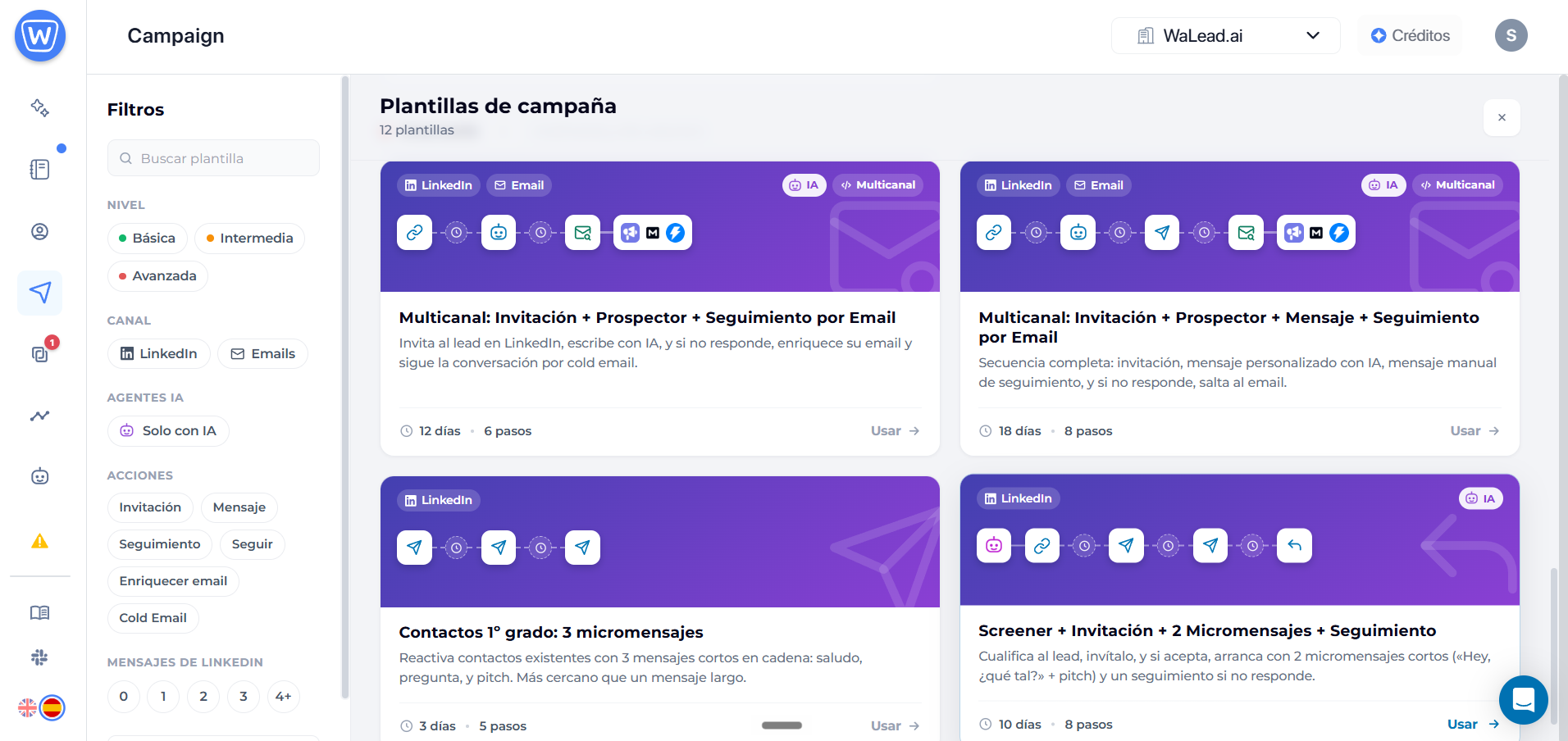
Here's the most practical fit difference in the whole comparison: WaLead ships with 12 defined campaign templates (multichannel, micro-messages, Screener + invitation, first-degree contact reactivation…) with their level, duration and steps already assembled. Pick one, tweak it and launch.
And when you want to go further, the same editor lets you build the sequence by hand: branches for accepted and rejected, waits, moves between campaigns and agents (Screener, Prospector, Scorer) as nodes in the flow itself. From template to agentic campaign without switching tools or ideas.
That's why WaLead fits SMBs, sales teams and GTM profiles so well: beginners lean on a template and produce on day one; those who know what they're doing build their own flow with agents, workbooks, webhooks and HTTP requests. Enginy targets its product at scale-up sales teams, with a demo-based buying process and a custom-prepared plan: a different buyer, a different pace.
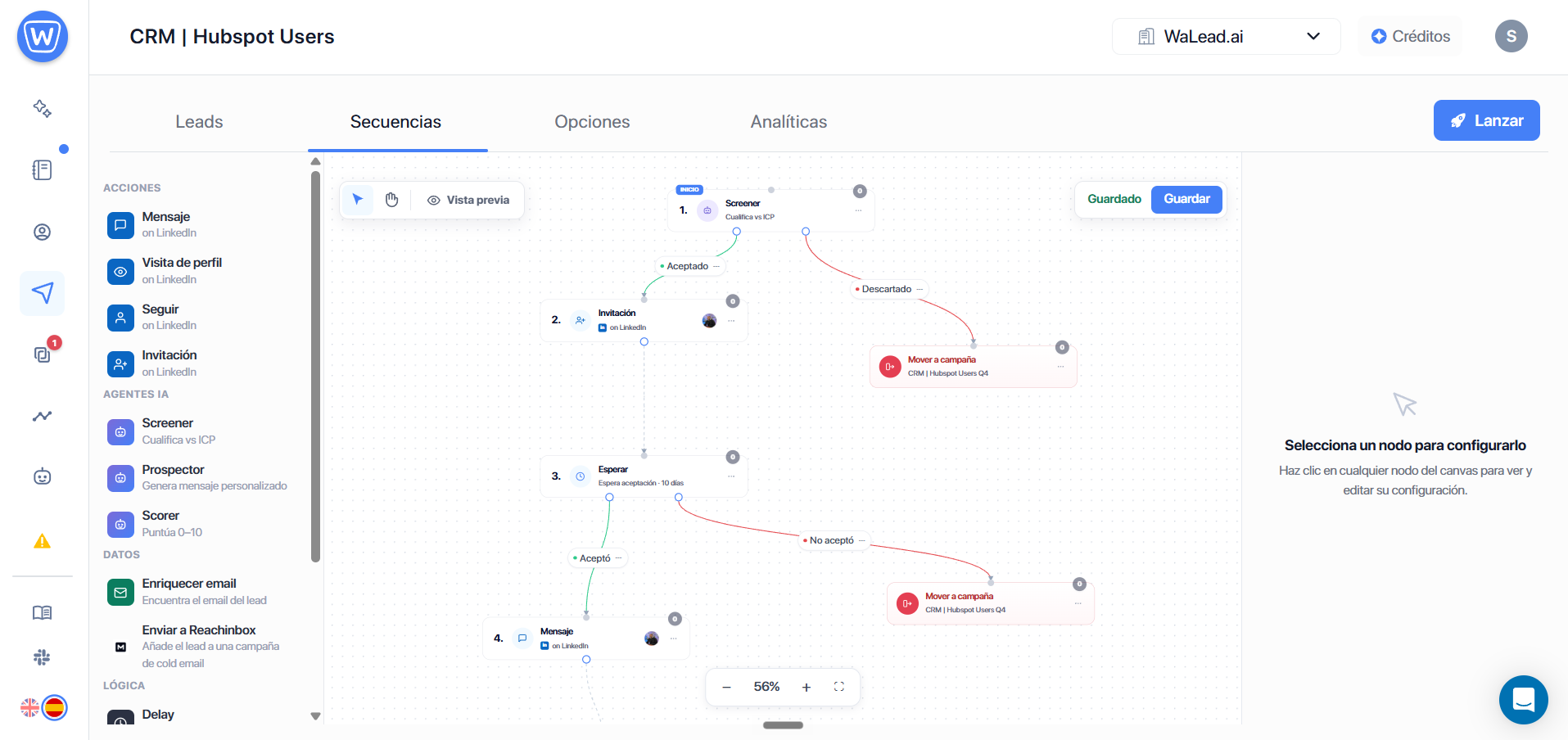
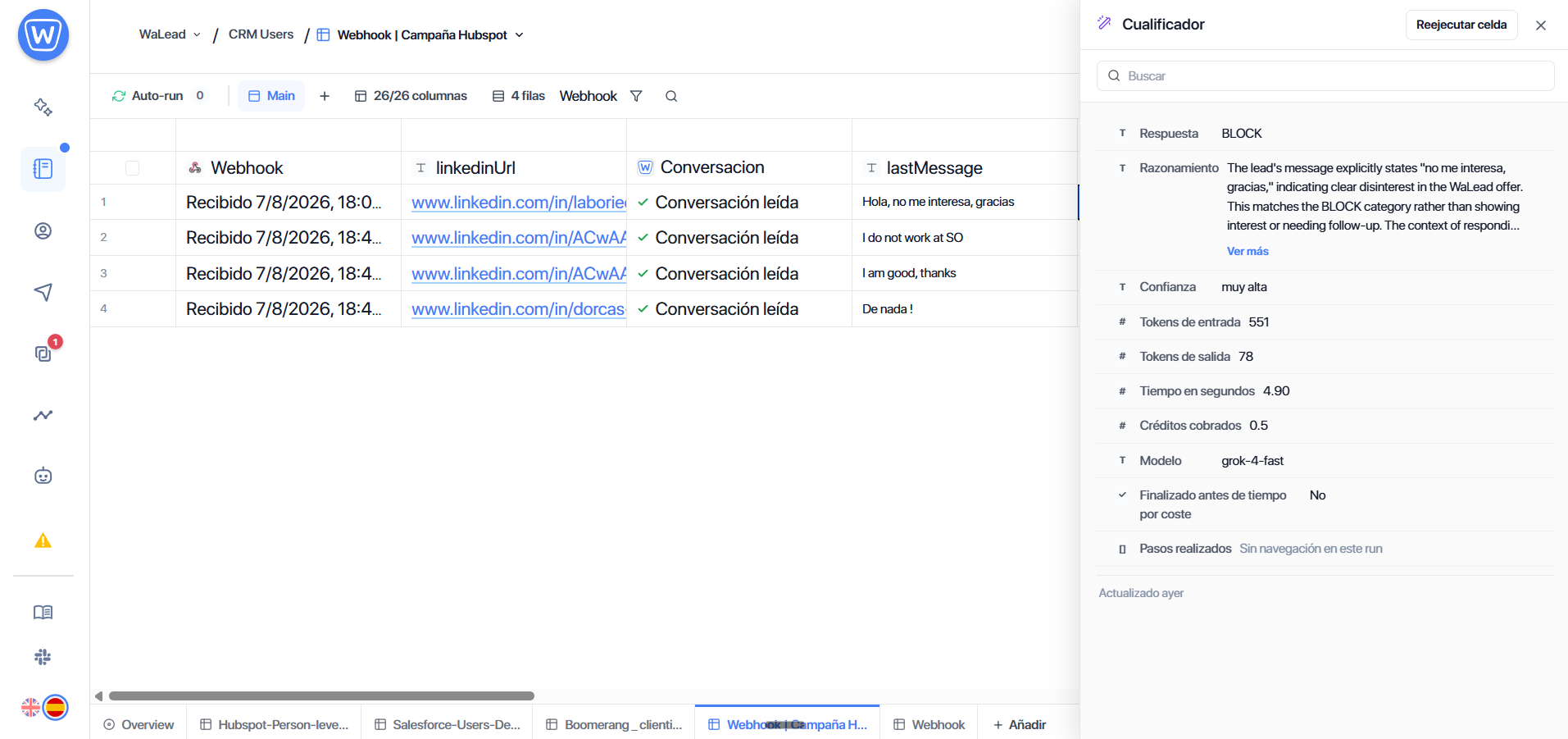
Enginy is built for a scale-up's buying cycle. WaLead is built so an SMB can launch its first campaign this very afternoon.
The rest of the flow, toe to toe
AI: Enginy has a conversational AI Finder, AI variables and inbox drafts. WaLead has agents with a name and a mission: Prospector (writes 1:1 after reading profile, posts and likes), Screener (deep research and qualification), Scorer (score-based branches), Closer (chats until the meeting) and Copilot, in basic and agentic campaigns with templates.
Intent signals: point for Enginy, no hedging. Hiring, funding, job changes and technologies as search triggers. WaLead doesn't have them today.
Multichannel: Enginy sends email from the platform itself with deliverability protection. WaLead delegates email to the specialists (Instantly, Smartlead and ReachInbox, natively integrated) and focuses on LinkedIn, the main channel of the Spanish market.
Integrations: CRMs in both. WaLead adds Spanish CRMs like Clientify, HTTP requests and webhooks in campaigns and workbooks, n8n, Make and Zapier, and native MCP in Claude.
Inbox: Enginy's Smart Inbox with intent auto-tagging and Slack alerts, credit where due. In WaLead, the Closer doesn't just tag: it chats and chases the meeting.
In what we both do, we play in the same league. The difference is what you can verify before signing.
Pricing: Enginy vs WaLead in 2026
Here we can't compare figure against figure, and that already says something: Enginy doesn't publish pricing (its page states they prepare a custom plan after learning about your business, checked in August 2026). What we can do is publish ours.
- LinkedIn automation with Health Score
- 16M contacts in Spain · 55M companies
- Email and mobile waterfall (20+ providers)
- AI agents and workbooks
- Unibox, CRM integrations and API
- Spanish-language support
Per sender, plus taxes. One single invoice and one single login.
- EnginyCustom demo-based plan
- Published pricenot published
- Trial without sales contactnot published
- Published LinkedIn protocolsnot published
- Published hit ratesnot published
Several invoices, several logins, and your data jumping from one tool to another.
Public pricing, 30 days to try it and no salesperson in the way.
Migrating from Enginy takes an afternoon
Same territory, same language: if you already work with enriched lists and multichannel campaigns, you'll feel at home in WaLead from day one.
Take your lists out of Enginy (or Genesy) into CSV or Google Sheets with whatever columns you already have.
WaLead deduplicates, re-enriches via a 20+ provider waterfall and leaves the contacts campaign-ready.
CRM, webhook or HTTP request, and the LinkedIn campaign with Health Score active. Spanish-language onboarding gets it running.
Which platform is right for your team?
Choose WaLead if…
- You're an SMB, a sales team or a GTM profile and want to launch your first campaign today with a template.
- You want to see the price, try it for 30 days and decide without going through a salesperson.
- LinkedIn is your main channel and you want published protection protocols, with zero documented bans.
- You want data figures you can hold us to: 16M in Spain, 94% email and 71% mobile.
- You're a freelancer, agency or sales team starting today, not after a demo cycle.
- You want an open ecosystem: Instantly, Smartlead, n8n, Make, Zapier and MCP in Claude.
Choose Enginy if…
- ✓You're a scale-up with a demo-based buying process and want a custom plan.
- ✓Intent signals (hiring, funding) are central to your prospecting.
- ✓You prefer to send cold email from within the platform itself.
- ✓You need ISO 27001 certification for your procurement paperwork.
Teams that already made the leap
The multi-account model is a before and after: you scale prospecting without sending costs through the roof. And the Spanish-language support gets you results fast.

We automate campaigns across several accounts safely and affordably. We've achieved 60% more meetings and save 2-3 hours a day.

Switching tools noticeably improved our sales process. The interface is clean and intuitive, and results come sooner.

Questions about WaLead and Enginy
What's the difference between WaLead and Enginy?▼
They're the two Spanish AI-powered B2B prospecting platforms and they share the essentials: data waterfall, AI and multichannel. They differ in philosophy: WaLead publishes its price (€65/sender/month) and its figures, and you can try it self-serve for 30 days; Enginy sells through demos, with custom plans.
Is it safe for my LinkedIn account?▼
We work within LinkedIn's limits (up to 800 invitations/month) and add real-time Health Score, a dedicated proxy per user and country, progressive warm-up, automatic withdrawal of pending invitations, and automatic pausing if we detect anomalies. We don't have a single review from a banned user.
How much does Enginy cost and how much does WaLead cost?▼
Enginy's pricing page doesn't publish plans: it states they prepare a custom proposal after learning about your business. WaLead publishes its price: €65/sender/month, everything included, with a 30-day trial and no mandatory demo.
How does the price compare to Enginy's?▼
WaLead costs €65/month per sender and includes the database, email and mobile enrichment, AI agents, workbooks and integrations. Around Enginy you need to add the pieces it doesn't include, each with its own invoice.
Do I need a card to try WaLead?▼
You can try WaLead for 30 days. Set up your plan and get started in minutes.
Is Enginy the same as Genesy AI?▼
Yes: Enginy is the new brand of Genesy AI, the Barcelona-based AI B2B prospecting platform.
Who has better data for Spain?▼
WaLead publishes its figures: 16M B2B contacts in Spain, 55M companies, 94% hit rate on email and 71% on mobiles, with a waterfall that includes Spanish specialists like MasLeads. Enginy communicates a 30+ source waterfall with no public coverage or hit-rate figures, so with public information a direct comparison isn't possible.
Do both automate LinkedIn?▼
Both offer LinkedIn actions. WaLead publishes its protection protocols (Health Score, dedicated proxy per user and country, auto-withdrawal) and its track record: zero documented bans. It's the question we recommend asking any provider before connecting your account.
Can I migrate from Enginy (or Genesy) to WaLead?▼
Yes: export your lists to CSV or Google Sheets and import them into a workbook, which deduplicates, re-enriches them via the waterfall and leaves them campaign-ready. Spanish-language onboarding walks you through the first one.
What does WaLead do that Enginy doesn't document?▼
Beyond the LinkedIn protocols and the public data figures: agentic campaigns with specialized agents (Prospector, Screener, Scorer and Closer), workbooks with HTTP requests and webhooks, connections to Instantly, Smartlead and ReachInbox, Spanish CRMs like Clientify and native MCP in Claude.
Does WaLead have intent signals like Enginy?▼
Not today, and we say so clearly: signal-based search (hiring, funding, job changes) is a point in Enginy's favor. In WaLead you can get close with activity filters, experience keywords and company lists for TAM.